


ABOUT
THE FORGOTTEN LEAGUE
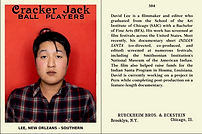
By Adam Chu
In 2009, while researching potential subjects for my first feature-length documentary film, I came across a brief mention of the National Girls Softball League (NGSL), later renamed the National Girls Baseball League (NGBL), on the Encyclopedia of Chicago website. At the time, I knew very little about the league, but the discovery immediately sparked my curiosity. I began searching for more information, hoping to uncover the story behind this Chicago-based institution.
What I found was surprising: almost nothing existed. Beyond a few scattered newspaper articles and brief references in the biographies of individual players, there was very little information about the NGBL. Although the league operated for eleven seasons in the Chicagoland area from 1944 to 1954, featuring talented ballplayers from across the United States and Canada, its complete history had never been documented.
I put my other projects on hold and began a journey to piece together the story of the National Girls Baseball League. Through years of archival research, newspaper searches, and connections with former players and their families, I have worked to document its history. While much has been discovered, many parts of the story remain unknown, and the work continues.
The documentary I was creating about the league was titled Their Turn at Bat. I envisioned the film as a way to bring the story of the NGBL and the women who played in it to a wider audience. I began filming, but ultimately was unable to secure the additional funding needed to complete the project. Rather than let the research and material I had gathered disappear, I continued to pursue the story. What began as a film eventually evolved into something much larger: a digital museum and archive dedicated to preserving and sharing this history.
WHY BASEBALL & SOFTBALL?
But this story did not begin with the NGBL. My fascination with baseball had been developing for years.
My family all followed the Chicago Cubs, but I became a Chicago White Sox fan. I was drawn to them because of players like Ron Kittle and Carlton Fisk, their 1980s logo, Comiskey Park, and those red, white, and navy blue jerseys with “SOX” across the chest. Then two movies came out that solidified them as my team: Eight Men Out and Field of Dreams. Those films sparked my obsession with White Sox baseball, but they also made me curious about the team’s past and why the White Sox figured so prominently in both stories. That curiosity led me to the Black Sox Scandal and opened the door to a much deeper interest in baseball history. I never had the opportunity to play the game myself, but I became a fanatic.
Then the 1994 players’ strike changed the way I experienced baseball. With MLB on hold, I began looking beyond the league for my baseball fix. Around that time, Ken Burns’ documentary Baseball introduced me to the Negro Leagues, while Sports Illustrated and the movie Mr. Baseball opened the door to Japanese baseball. The St. Paul Saints and the Northern League introduced me to independent baseball, while Ila Borders and the Colorado Silver Bullets showed me that there were still barriers being challenged on the diamond. The 1996 Olympics introduced me to softball, and I began following that sport as well.
Soon, my fascination grew beyond simply watching games. I became captivated by the leagues, teams, players, ballparks, and stories that made each baseball and softball world unique. Eventually, that curiosity led me to the forgotten history of women’s baseball and softball—and to the creation of Their Turn at Bat.
FROM FILM TO DIGITAL MUSEUM
Two additional films were envisioned as part of the trilogy, She’s Up Next and Heart of the Order. While those films will probably never get completed, the ideas behind them remain part of the larger project and its mission to bring to light the stories of women whose contributions to baseball and softball have been overlooked.
Another project to emerge from this work is Hidden Lineup, which explores the history of Black women in softball. The title is a play on the film Hidden Figures, a nod to the contributions that have been left out of the historical record.
Today, Their Turn at Bat exists as a digital museum and archive dedicated to preserving and sharing the history of the National Girls Softball League / National Girls Baseball League and the broader history of women’s baseball and softball. The goal is not simply to remember the past, but to make these stories accessible to a new generation and to continue discovering the people, teams, leagues, and stories that haven't been told.
THE NATIONAL GIRLS BASEBALL LEAGUE
The National Girls Baseball League was a professional women’s fastpitch softball league founded in 1944 with five clubs, four from the Chicagoland area, along with one ballclub that relocated from Cleveland to join the league. A sixth team was added the following year. For more than a decade, the league provided women with the opportunity to compete at a high level and helped sustain fastpitch softball in the Windy City during the postwar era.
The NGBL competed alongside the better-known All-American Girls Professional Baseball League (AAGPBL), but the spotlight has largely remained on the All-Americans. While the AAGPBL has become an important part of baseball history, the NGBL represents another chapter in the history of women’s diamond sports.
This is the story of the National Girls Baseball League—and the men and women who helped build it.
TEAM
.png)



THANK YOU
This museum would not be possible without the many people who have shared their time, knowledge, photographs, stories, and memories. I am grateful to the families, researchers, historians, collectors, and fellow enthusiasts who have helped uncover the stories preserved here and have generously shared pieces of the past that might otherwise have been lost.
• Aaron Moore • Ann Kmezich Fatovich • Arizona Softball Foundation • Bill Plummer III • Bud Eckholm • Chicago Bandits • Chris Lamberti • David Frank •
• Diane Holder Smith • Dorothy Gramberg • Elisabeth Smith • Emily Alexander • Emma Foster • Erica Gunderson • Erma Bergmann • Esther Mackey • Eva Chu •
• Flobo Boyce • Frank Petrovic • Forrest Wagner • Geoffrey Baer • Gwen Wong • Historical Society of Forest Park • Irene "Pepper" Kerwin • James Lundgren •
• Jerry Parichy • Joanne "Becky" Beckman • Jody Marsh • Joy Bussert • Kevin Johnson • Laura A. Purcell • Linda Stude • Manseen Logan •
• Mary Lou Pennington • Oliver Chapman • Rogers Park / West Ridge Historical Society • Paula Weaver • Phil Schwartz • Rosemary Massa • Sindy Quigley •
• Stormy Irwin • Suzi Spangenberg • Terry Donahue • Terry Pierce • Tim Hanlon • Tim Wiles • Wanda Chapman • William Strnad • And more to come... •
.png)